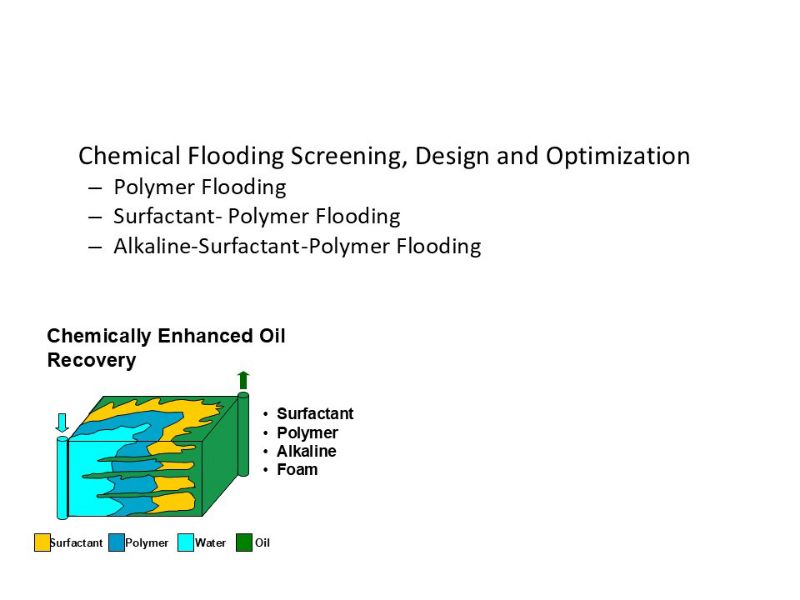
Polymer Flooding - an enhanced oil recovery (EOR) technique where water-soluble polymers are added to injected water to increase its viscosity. This makes the water more effective at pushing oil through a reservoir, improving sweep efficiency and leading to a higher recovery of oil that was left behind by conventional waterflooding. The thickened water reduces viscous fingering, where the water channels through high-permeability areas, and forces it to move more evenly through the reservoir, displacing more oil.
Surfactant- Polymer Flooding - an enhanced oil recovery (EOR) technique that injects a chemical mixture of surfactants and polymers into an oil reservoir to recover more oil than conventional methods. The surfactants reduce the oil-water interfacial tension (IFT) to release trapped oil, while the polymers increase the viscosity of the injected water to improve mobility control and sweep efficiency, ensuring the oil is pushed out of the reservoir more effectively.
Alkaline-Surfactant-Polymer Flooding - a chemical enhanced oil recovery technique that involves injecting a mixture of three components—alkali, surfactant, and polymer—into an oil reservoir to mobilize and recover additional crude oil. The alkali reacts with oil to generate natural surfactants, the added surfactant reduces the tension between oil and water to mobilize trapped oil, and the polymer increases the viscosity of the injected water to improve its sweep efficiency. The combined, or synergistic, effect of these chemicals is more effective than using any single component alone