Our Services
Gas Injection
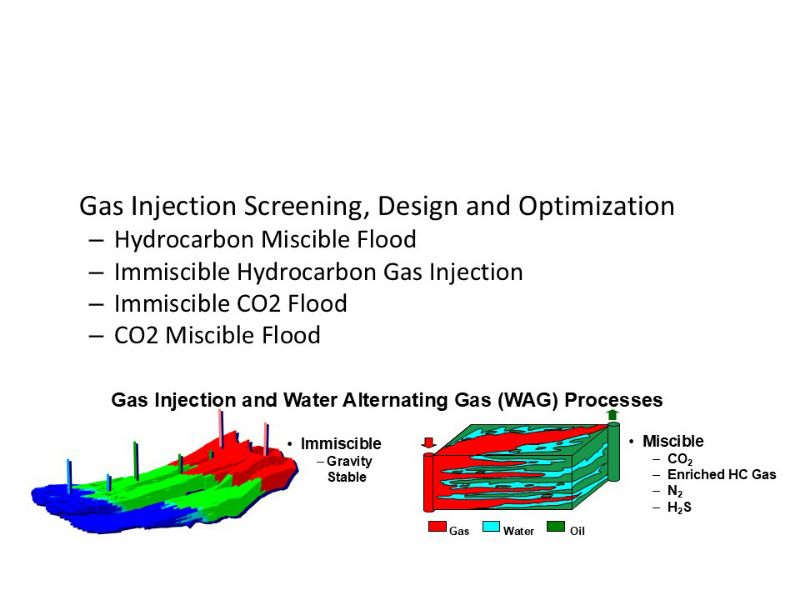
- Hydrocarbon Miscible Flood - an enhanced oil recovery technique where a hydrocarbon gas or liquid is injected into a reservoir to mix with and displace crude oil. This process works by reducing the oil's viscosity and lowering the interfacial tension between the oil and gas, effectively making them one fluid phase once a specific minimum miscibility pressure (MMP) is reached. The goal is to recover more oil from mature reservoirs that have been partially depleted by primary methods or waterflooding.
-
- Immiscible Hydrocarbon Gas Injection - an enhanced oil recovery technique where hydrocarbon gas is injected into an oil reservoir without dissolving completely in the oil, which displaces the oil and maintains reservoir pressure. This process increases the amount of oil recovered compared to natural depletion by expanding the gas and physically pushing the oil towards production wells, similar to a compressed spring. It is often used in conjunction with water injection, in a water-alternating-gas (WAG) pattern, to improve displacement efficiency.
-
- Immiscible CO2 Flood - a process used for Enhanced Oil Recovery (EOR) where carbon dioxide is injected into an oil reservoir below the Minimum Miscibility Pressure (MMP). In this process, the CO2 does not mix with the oil to form a single phase but improves oil recovery through several mechanisms, including swelling the oil, reducing its viscosity, and decreasing the interfacial tension between the oil and rock. It is a method particularly suited for heavier oils and can be used in both high-permeability and low-permeability reservoirs.
-
- CO2 Miscible Flood - an enhanced oil recovery (EOR) technique that involves injecting compressed carbon dioxide into a depleted oil reservoir to recover more oil. The injected CO2 mixes with the oil, causing it to become a single fluid phase with no interfacial tension, which significantly reduces its viscosity and allows it to be mobilized from the reservoir more easily. This method is effective for medium to light oils and helps in the simultaneous storage of CO2.